
One engine is one company's answer.
Ask them all at once. See which results hold up.
Pelorus Search runs one query on Google, Bing, Brave, DuckDuckGo, and ten more engines, merges the results, drops the duplicates, and puts the pages more than one engine found at the top. For OSINT practitioners, journalists, and analysts who need to know what one engine is not showing them.

iPhone iPad Mac Winter 2026


Every engine is shaped by the company that runs it.
A single search engine is one company's view of the web, ranked by that company's rules and its advertising priorities. Ask Google and Bing the same question and you get two different lists. If you only ever see one of them, you don't know what you're missing.
A few pages show up on both lists. Those are the interesting ones. When more than one engine finds the same page on its own, it's usually the page you wanted. Pelorus puts it first.
Every engine, one list.
Unified Search merges the results of the engines you turned on, drops the duplicates, and puts the pages more than one engine found on its own at the top. That's what holds up: found by several, not picked by one.
Fourteen engines, including Google, Bing, Brave, DuckDuckGo, Wikipedia, the Internet Archive, and academic and technical sources. Or add your own.
Swipe between engine cards to compare what each one found, or run All Engines for one card per engine, side by side.
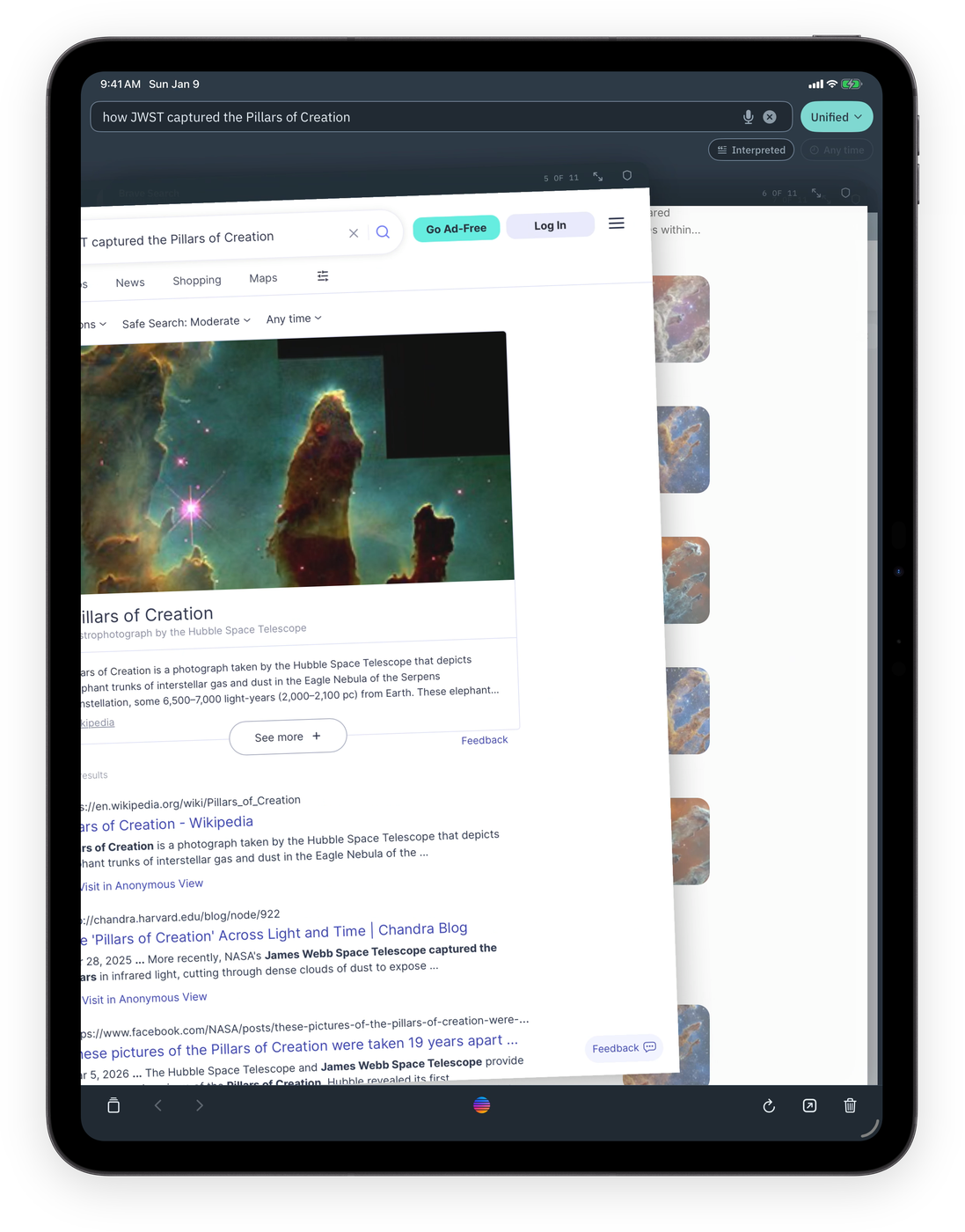

Results you can work with.
Pelorus Insights.
Facts about your search. What every engine agreed on. What only one engine found. Where they disagreed most. Whether one website is quietly taking over the top of your list.

Pelorus Cross-Check.
A short note at the end of an AI synthesis says which of its claims were found by more than one engine on its own, and which rest on a single source. Pelorus computes the counts from the results directly; no AI models are used to validate their own claims. It answers the question a single search engine structurally can't: does this hold up?

- Disagreement and single-engine filters.
- Agreement is the default, not the limit. Filter Unified Search for what only one engine found, or for where the engines disagree most. The pages one index has and the others don't are often the ones worth a second look.
- Explain.
- See how Unified Search gathers, de-duplicates, and ranks results, and which engines contributed to this search. Turn on result details to see which engines found each result and where they ranked it.
Pelorus Insights, the filters, and Pelorus Cross-Check are part of Pelorus Unlimited, a one-time purchase. Explain is in the free app.


One search engine is one company's answer.
Pelorus asks them all, then shows you which results hold up.
No subscriptions. No ads. No account. And a browser that forgets everything when you tap Erase.

Free to download. Unlimited is a one-time purchase. Requires iOS 17 or later.